Being called Imbokodo is a rite of passage for a South African woman, serving as the ultimate badge of honour that evokes the fierce defiance of the historic 1956 march. Yet across the decades, our highest cultural compliment has metastasised into an inescapable job description.
In this deep dive, mental health counsellor Devan Moonsamy dissects the psychological machinery of the “Superwoman Schema”, interrogating the cost when a society stops admiring how women thrive, and instead normalises how relentlessly they survive.
The Weight Behind The Myth
According to the latest South African Police Service (SAPS) crime statistics and South African Medical Research Council (SAMRC) research, South Africa continues to have one of the highest rates of gender-based violence and femicide in the world. More than 42 700 rapes were reported in the latest annual crime statistics, while researchers and public health experts warn that sexual violence and abuse remain significantly under-reported.
And yet, when she survives – when she buries a husband, raises four children on one income, cares for an ageing parent, walks away from abuse, and still arrives at work with her lipstick on – we call her a rock.
We call her Imbokodo. We mean it as the highest compliment. Perhaps it is time we asked whether it has also become one of our greatest psychological burdens.
READ MORE: 18 Mental Health Books For Anxiety, People-Pleasing And More
What Imbokodo Was Always Meant To Represent
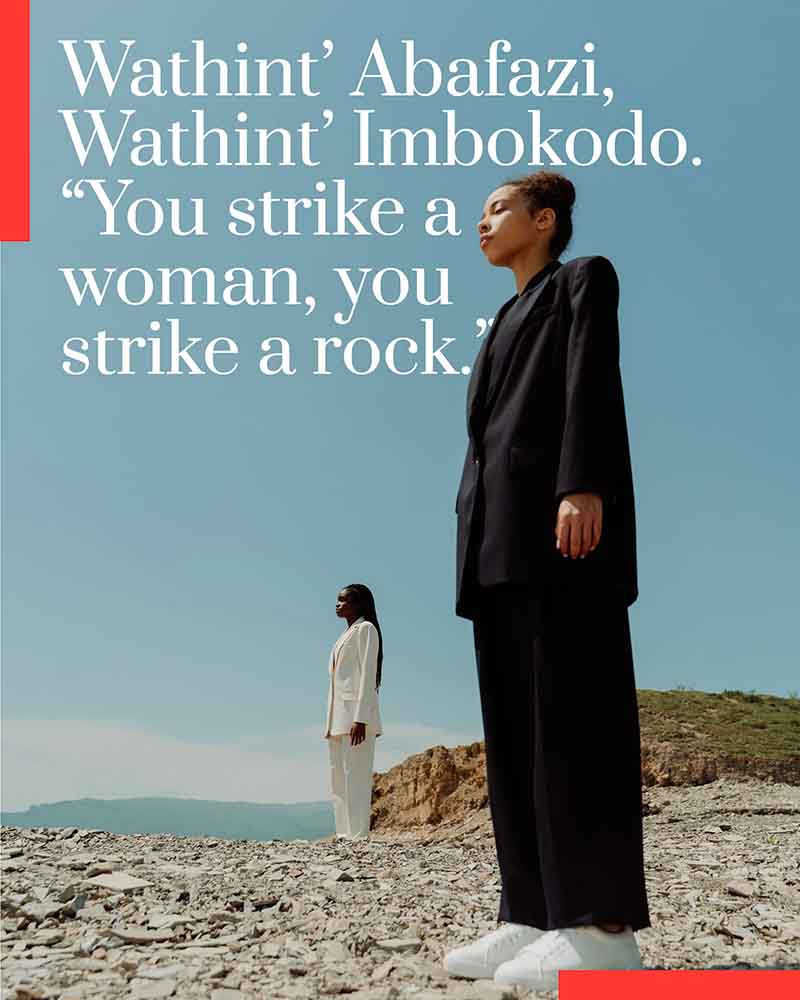
In 1956, twenty thousand women of every race marched to the Union Buildings in Pretoria to challenge apartheid’s pass laws. They sang: Wathint’ Abafazi, Wathint’ Imbokodo. “You strike a woman, you strike a rock.”
Those words were never intended to describe how women should live. They were a warning to power. They declared that women would not be broken by injustice. The metaphor faced outward, confronting oppression. It celebrated courage, solidarity and resistance.
Nearly seventy years later, something has changed. The same words that once challenged institutions have quietly become an expectation placed upon women by those very institutions. The praise poem has become a job description. Somewhere between 1956 and today, resilience stopped being honoured and started being expected.
The Mental Load South African Women Continue To Carry
Statistics South Africa estimates that around 42% of South African households are headed by women, while approximately 7.4 million women are the sole or primary breadwinners in their homes. At the same time, the Human Sciences Research Council found that approximately one in three South African women has experienced physical violence during her lifetime – more than seven million women. Many of these same women are carrying another burden that receives far less attention: an escalating mental health crisis.
The South African Depression and Anxiety Group reports receiving approximately 3 000 calls every day, while fewer than one in ten South Africans living with a diagnosable mental health condition ever receive treatment. In isiZulu, one of South Africa’s most widely spoken languages, clinicians and researchers have noted that depression is often understood and expressed through culturally specific descriptions of distress rather than a direct biomedical label.
It is often not spoken. It is simply carried. And perhaps that is exactly the problem.
What Is The Superwoman Schema?
Every time a woman’s suffering is reframed as proof of her strength, someone else is relieved of the responsibility to change the conditions causing that suffering. We celebrate endurance. We admire sacrifice. We applaud resilience. But we ask far less often why extraordinary resilience has become necessary in the first place.
Psychologists have a name for this phenomenon.
They call it the Superwoman Schema – the internalised belief that a woman must always appear strong, suppress emotional pain, care for everyone else, and succeed regardless of the personal cost. Dr Cheryl Woods-Giscombé’s pioneering research linked this pattern with chronic stress, anxiety, depressive symptoms and stress-related physical illnesses, including hypertension, obesity and adverse pregnancy outcomes.
More recent research has reached a similarly concerning conclusion: women who most strongly internalised the “Strong Black Woman” identity reported significantly poorer mental health outcomes than women who internalised it less strongly.
Strength, it turns out, can become psychologically expensive.
The Mental Health Cost Of Always Being “The Strong One”
South African feminist scholar Pumla Dineo Gqola offers another lens through which to understand this reality. In Female Fear Factory, she argues that violence against women is sustained not only by those who commit it, but also by cultural narratives that make living with that violence seem normal or inevitable.
Seen through that lens, the weaponised Imbokodo myth becomes deeply uncomfortable. It does not stop women from being struck. It simply makes us admire how well they survive the blow.
A rock does not ask for help. A rock does not need therapy. A rock does not need flexible working hours, paid leave, affordable childcare, functioning policing, trauma counselling or someone to say, “You don’t have to carry this alone.”
That is precisely why the metaphor has become so useful to everyone except the woman living inside it.
The cost is rarely dramatic collapse. More often, it is the woman who continues performing. She keeps working. She keeps parenting. She keeps caring for everyone around her. She smiles. She meets every deadline. She asks everyone else whether they are okay. All while carrying the invisible biological consequences of chronic, unrelieved stress.
Resilience is not proof that someone is coping. Sometimes it is evidence that nobody came to help.
None of this diminishes what Imbokodo meant – or what it should continue to mean. It deserves to be spoken with pride. It should remain a symbol of courage, resistance and the extraordinary contribution South African women have made to this country’s history. But there is a profound difference between honouring a woman’s strength and quietly requiring it. South Africa has blurred that line. And women are paying the price in silence, in burnout, in illness, and in lives cut short.
READ MORE: 8 Things That Could Be Stealing Your Joy Right Now

How We Can Support Women Each Other
Changing this narrative does not require abandoning Imbokodo. It requires restoring its original meaning.
At home, stop praising women only for how much they endure. Ask what support they need. Share caregiving, emotional labour and household responsibilities instead of assuming women will naturally carry them.
At work, organisations must stop rewarding silent endurance and start creating psychologically safe workplaces where asking for help is viewed as strength rather than weakness. Employee Assistance Programmes, flexible work arrangements and visible leadership support for mental well-being should become standard practice – not optional benefits.
As a society, we must stop celebrating resilience while tolerating the conditions that make resilience necessary. Preventing gender-based violence, improving access to mental healthcare, strengthening policing and supporting caregivers are not acts of charity. They are investments in the well-being of our nation.
Real empowerment is not measured by how much suffering women survive. It is measured by how much unnecessary suffering we prevent.
READ MORE: 10 Inspiring Stories That Will Uplift You This Women’s Day
The Most Important Question South Africa Needs To Ask
The question South Africa has never honestly asked is not whether its women are strong. Generations of women have answered that question already. The real question is why we have made strength their only acceptable state. Perhaps the greatest way to honour Imbokodo is not to keep asking women to be rocks. Perhaps it is to build a country where they no longer have to be.
A rock can hold up a house for a hundred years. But even rock erodes when nothing is ever done to protect it.
Words by Devan Moonsamy, mental health counsellor and CEO of The ICHAF Training Institute, with additional reporting by the Women’s Health SA team.