Being an Online Editor requires me to be online. A lot. I need to know which team won this weekend at the Games (Springboks! Proteas!), which wellness hack everyone is suddenly obsessed with, the latest meme, the trending song, the TikTok dance (skeur hom…) and, generally, what’s happening on the internet before everyone else has moved on to the next thing. Being glued to a screen is part of the job.
But lately, I’ve been craving the exact opposite. I want a more analogue lifestyle, where the time I do spend online feels intentional and structured, rather than disappearing into a few hours of scrolling that I can’t quite account for.
So, when Garmin launched its CIRQA Smart Band, a screen-free health and fitness tracker, I was very keen to try it. Could I still get all the health and fitness data I love without having another tiny screen on my wrist to check every five minutes? More importantly, would removing one more screen from my day actually change how present I felt? I gave it a few weeks to find out.
READ MORE: How To Have A Healthier Relationship With Fitness Apps, Without Quitting Exercise
Being Offline Is Now Considered “Cool”
Corded earphones are back. Flip phones are having a moment. People are picking up analogue hobbies, swapping scrolling for reading and, yes, even pedal pushers have made a comeback. If I can dare to say it, we are nostalgia-maxxing. Gen Z has embraced the digital detox and millennials aren’t exactly rushing to give up their screen-free Sundays either.
But here’s the thing: South Africans are still very online. According to DataReportal’s Digital 2025: South Africa report, 50.8 million people in South Africa were using the internet at the start of 2025, while there were 26.7 million social media user identities. That’s 78.9% of the population online, with the number of social media user identities increasing by 700 000 compared with the previous year.
And we’re spending a serious amount of time there. Meltwater’s analysis of the same Global Digital Reports data found that South African internet users spent an average of 3 hours and 36 minutes a day on social media, considerably higher than the global average of 2 hours and 21 minutes. So, no, we’re not exactly putting our phones down.
The Digital Dump
What does seem to be changing is how we feel about all that screen time. Deloitte’s latest Digital Consumer Trends research in the UK found that 20% of consumers had deleted a social media app in the previous year, rising to 29% among Gen Z. Half had switched off all notifications for at least one app, while 18% had introduced screen-time limits. Among those who deleted an app, 25% said it was because it consumed too much of their time, while 20% cited a negative impact on their mental health.
And that feeling of spending too much time online shows up in Deloitte’s latest survey, too. The 2026 research found that 66% of Gen Z respondents often spend longer on social media than they intend to, while 43% believe social media is harmful to their mental health.
Alongside our own country’s eye-wateringly high social media use, it points to a broader tension: we love being connected, but we’re starting to think a little harder about how much access we actually want to give our screens. Which brings me to the watch…
READ MORE: 5 Science-Backed Benefits Of ‘Grandma Hobbies’
Why Does A Screen-Free Watch Matter?
You might be wondering what social media has to do with a fitness tracker. Quite a lot, actually. I’ve always loved having health data at my fingertips. Heart rate, steps, sleep, recovery, training readiness. Give me a list of numbers and I’ll happily analyse it over my morning coffee. I’m that person. But there’s a difference between choosing to look at your data and having another screen constantly asking you to.
One of my biggest pet peeves is sitting across from someone while they repeatedly glance at the notifications lighting up on their watch. It’s not quite as obvious as scrolling through your phone, but the effect is similar. Your attention has left the room.
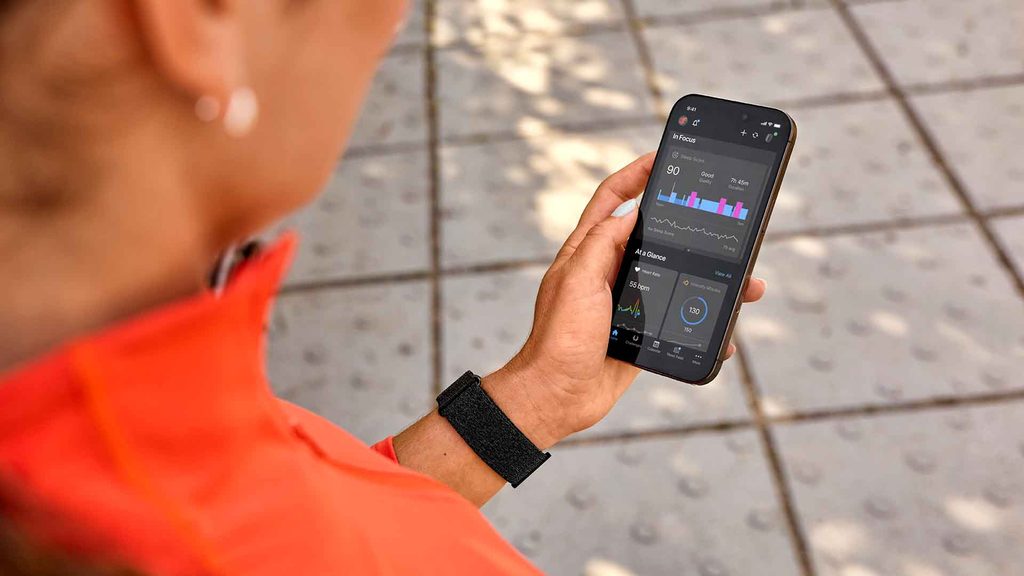
That’s what made the idea of a screen-free tracker so interesting to me. CIRQA collects the data in the background, then lets you look at it later in the Garmin Connect app. You can check your steps, activities, sleep, heart rate and other health metrics when you choose to, rather than every time your wrist lights up. Garmin says the band provides 24/7 health monitoring, tracks more than 80 activities and offers up to 10 days of battery life.
It sounds like a small change, but taking away the screen made me realise how often I was checking my watch simply because I could.
READ MORE: Your Fitness Tracking App Is Sharing More Than Your Step Count – Here’s How To Fix It
Unboxing And Initial Thoughts
I went for the bone-coloured version, which I absolutely love. Everything I own is some variation of beige, cream or a muted colour, so it slots quite happily into my wardrobe and doesn’t compete with the rest of my jewellery.
My first thought was that the sensor itself would be flatter, almost like an RFID tag. It isn’t. There’s a small device beneath the fabric band, so if you’re imagining something completely flat against your arm, adjust those expectations. It needs room for the sensors, after all.
The more interesting adjustment was psychological. On the first day, I probably looked at my wrist about 2 000 times. Not because there was anything there to see, but because I’d become so accustomed to checking it.
It’s the same reflex we have with our phones. A quick check. Seeing what came through. Maybe checking the time. Before you know it, you’ve opened an app you didn’t intend to open and somehow you’re watching a video about someone’s fridge organisation. Taking away the screen made me realise just how automatic that behaviour had become.
Set-Up
As an existing Garmin user, set-up was incredibly straightforward. I opened the Garmin Connect app, and it immediately detected the band. From there, I selected my favourite activities and went through a brief how-it-works tour. And that was basically it. No complicated faffing around. No lengthy set-up process.
READ MORE: The Gross Truth About Your Smartwatch (And How To Fix It)
Next Up: Actually Testing It
Activity
Running was the first activity I selected. CIRQA can automatically detect a variety of activities, including running and walking, while more than 80 activities can be tracked manually. You can confirm or edit automatically detected activities afterwards in Garmin Connect, and the band adapts to more accurately classify them in future.
If you’re someone who tends to start running and forget about your watch until you’re halfway through, this is particularly handy. But I preferred manually starting my run by pressing the button as I set off. That way, I knew I was tracking it from the beginning and could see the relevant data afterwards in the app.
I also swim regularly, so I was initially convinced the fabric strap was going to come out of the pool feeling like a soggy dishcloth. Thankfully, it dries surprisingly quickly. CIRQA is also rated to 5 ATM for swimming.
Sleep
My arms tend to swell during the night, and I’ve often woken up and found my smartwatch somewhere in my bed in the morning, after taking it off sometime in the night because it becomes uncomfortable. The CIRQA band is soft and flexible enough that I barely notice it while I’m sleeping. That matters because Garmin’s sleep tracking goes well beyond simply telling you how long you were asleep. It records sleep stages, sleep score, heart rate variability, respiration, naps and skin temperature, while the app also provides sleep coaching and training-readiness information.
I’m not exactly the poster child for sleep tracking. I have two toddlers, so “getting enough sleep” is sometimes less of a wellness goal and more of a distant fantasy. Still, recovery matters and sleep is a huge part of it. Having the information there the next morning, ready to look through with my first cup of coffee, felt much more useful than checking a glowing screen in the middle of the night.
READ MORE: I Get Five Hours Of Sleep Each Night But Feel Totally Fine. How Bad Is That, Really?
The Data
I’m a classic Type A when it comes to data. Give me a list, a graph or a number and I’m hooked. CIRQA doesn’t disappoint here. All the information is pulled into Garmin Connect, where I can look at things like heart rate, steps, sleep, recovery and training readiness. It also tracks Body Battery, stress, Pulse Ox and skin temperature.
The big difference for me was that I wasn’t constantly looking down at the numbers throughout the day. I waited until I actually wanted to see them, then opened Garmin Connect and took in the bigger picture.
Instead of checking my wrist halfway through a workout to see what my heart rate was doing or how far I’d gone, I could just focus on moving. I wasn’t getting sidetracked by numbers or worrying about whether I was hitting a certain target.
Did It Make Me A More Present Person?
In short, yes. Not dramatically. I’m not suddenly living in a cottage with no Wi-Fi, churning my own butter and writing letters by candlelight, but I did notice a shift.
With the sheer amount of information we’re dealing with every day, the constant notifications, AI-generated content flooding our feeds and the general pressure to know what’s happening at all times, having one less screen to check made a difference.
I found myself listening more, rather than constantly keeping tabs on the next buzz or wondering what I’d missed. When someone was talking to me, my attention stayed with them instead of drifting towards my wrist. The same thing happened during workouts. Without numbers flashing up in front of me, I could focus on the actual movement and leave the data for later. The funny thing is, I didn’t realise how much I’d been checking my watch until there was nothing to check.
Did I miss having a flashlight and maps guiding me on my running route? Absolutely. But there’s definitely a place for a watch like this, especially if being more present and intentional with your screen time is the goal.
READ MORE: Garmin’s First Screen-Free Fitness Tracker Is Made For Your Digital Detox
The Bottom Line
If you’re looking for a health and fitness tracker that collects your data while you get on with your day, CIRQA makes a compelling case. You still get a surprisingly comprehensive set of health, sleep and fitness insights, including heart rate, steps, sleep tracking, training readiness, HRV status, VO2 max and recovery information. And because the screen is gone, you have to be a little more intentional about when you look at that information.
That won’t suit everyone. If you’re a serious athlete who wants maps, live workout data and more detailed information directly on your wrist, you’d probably be better served by one of Garmin’s more advanced watches. CIRQA is designed for a different kind of user: someone who wants the data, but doesn’t necessarily want to see it all day long.
For me, that’s the appeal. I’m not trying to disappear from the internet. That’s literally my job. I just want to decide when I’m on it. And sometimes, the best thing a piece of technology can do is give you one less reason to look at it.